
Sep 22nd 2026
What Is G10 and Why Choose It as Your Non-Metallic Knife?
Have you ever searched on google for a non-metallic knife? Then you have probably seen several different materials used to make them. G10, carbon fiber, ceramic, Zytel, glass-filled nylon and other polymers show up in this category. All are current options in this market, but they all carry different characteristics.
We have been making non-metallic knives from G10 for nearly a decade because it gives us the combination of strength, rigidity, low weight and durability we want in an everyday-carry tool. It is also electrically insulating, resistant to moisture, extreme cold and heat and capable of being machined into precise shapes without relying on a metal core.
What Is G10?
G10 is a fiberglass and epoxy laminate made by stacking layers of woven fiberglass cloth, saturating them with epoxy resin and curing the material under heat and pressure.
The finished product is dense, rigid and extremely durable. G10 has long been used in electrical, aerospace, marine, firearm and industrial applications because of its strength, dimensional stability and electrical insulation.
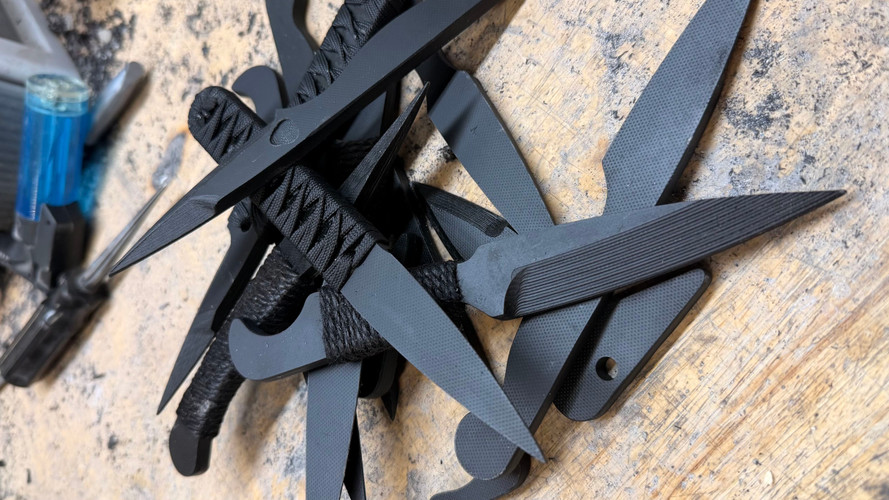
Black Triangle machines our knives from solid G10 stock rather than using it only as a handle material. The result is a fully non-metallic knife with no steel blade or hidden metal core.
Why Use G10 for a Non-Metallic Knife?
Making a knife without metal is easy. Making one that is strong, rigid and useful is where material choice becomes important.
G10 offers excellent stiffness and structural strength while remaining lightweight. Because it is machined rather than injection molded, we can control the shape of the tip, edge, handle and grip texture much more precisely.
A G10 knife should not be thought of as a steel knife made from a different material. G10 has different strengths and limitations, and the design should take advantage of them.
G10 vs. Carbon Fiber
G10 and carbon fiber are both lightweight composite materials, but they differ in one important way: carbon fiber is electrically conductive while G10 is an electrical insulator.
Because the carbon fibers themselves conduct electricity, carbon fiber can sometimes produce enough of an electromagnetic response to register on a metal detector. This varies depending on the detector, sensitivity, construction of the object and orientation of the fibers.
That is one reason we do not consider carbon fiber interchangeable with G10 for a non-metallic knife. Carbon fiber has plenty of useful applications, but for this particular purpose we prefer the electrical insulation, durability and overall balance of G10.
G10 vs. Ceramic Knives
Ceramic knives can hold an extremely sharp edge, which makes them useful for kitchens and certain cutting tasks.
The tradeoff is brittleness.
A ceramic blade can be extremely hard while still being vulnerable to chipping or fracture if it is dropped or subjected to impact. That is less desirable for a tool that may spend years being carried, dropped or used outside of simple slicing tasks.
For a non-metallic self-defense knife, we care more about structural integrity, durability, grip and reliability than producing a razor-thin cutting edge.
G10 vs. Polymer Knives
Polymer knives are commonly made from materials such as nylon, glass-filled nylon and Zytel.
Injection molding allows these products to be made quickly and relatively inexpensively, but many molded polymers have more flex than G10. G10 uses woven fiberglass reinforcement throughout the material, giving it excellent rigidity without requiring a metal insert.
The downside is that G10 is slower and more expensive to manufacture. Every Black Triangle G10 knife begins as sheet stock and is individually machined into its finished shape.
We think the finished product is worth the extra work.
Is G10 Plastic?
Technically, G10 contains a polymer because epoxy resin is used to bond the material together, but calling it plastic does not really describe how it behaves.
Its strength comes from layers of woven fiberglass bonded together with epoxy resin. A rough comparison would be plywood, where multiple layers combine to create something stronger and more stable than the individual components.
Once cured, G10 becomes a dense and rigid fiberglass laminate that can be machined into a finished knife.
Is a G10 Knife Completely Non-Metallic?
The knife itself, as well as the sheath and attachment hardware is 100% metal-free.
That does not mean it is invisible to security equipment. Modern screening systems include X-ray machines, body scanners and other technology that can detect objects regardless of whether they contain metal. G10 knives are made to defeat walkthrough metal detectors, wands and "A.I." systems such as Evolv and OpenGate.
Non-metallic describes the construction of the knife, not an exemption from laws, security procedures or screening equipment.
Can You Sharpen a G10 Knife?
A G10 knife does not sharpen the same way a conventional steel knife does, and it should not be expected to hold the same type of fine cutting edge. We have experimented with putting an edge on our knives but they do not last and constant resharpening will reduce mass from the blade and it will eventually disappear. Any G10 knife maker that claims that having an edge on their products as an advantage is misleading their customer base.
The geometry on the tip of the knives is where we focus our efforts. Each knife SKU is thouroughly tested on clothing and on an organic testing subject.
In most cases, there is very little maintenance required. If the tip becomes rounded or damaged, a 60 to 80 grit sanding sponge can be used to carefully re-point it and restore the original geometry.
You should avoid breathing fiberglass dust (use a respirator!) when sanding G10 and work in a well-ventilated area.
Black Triangle G10 knives are also covered by our lifetime guarantee. If your tool is damaged during normal use, send it back to us and we will repair or replace it.
Why Does Black Triangle Use G10?
We use G10 because it gives us the best overall balance for a non-metallic knife.
It is strong, rigid, lightweight, electrically insulating, resistant to the elements and durable enough for everyday carry.
All of our G10 Knives>>>click here.
There are cheaper materials and easier manufacturing methods, but for the type of non-metallic self-defense tools we build, G10 continues to be the material we prefer.